
1. What is local business ranking?
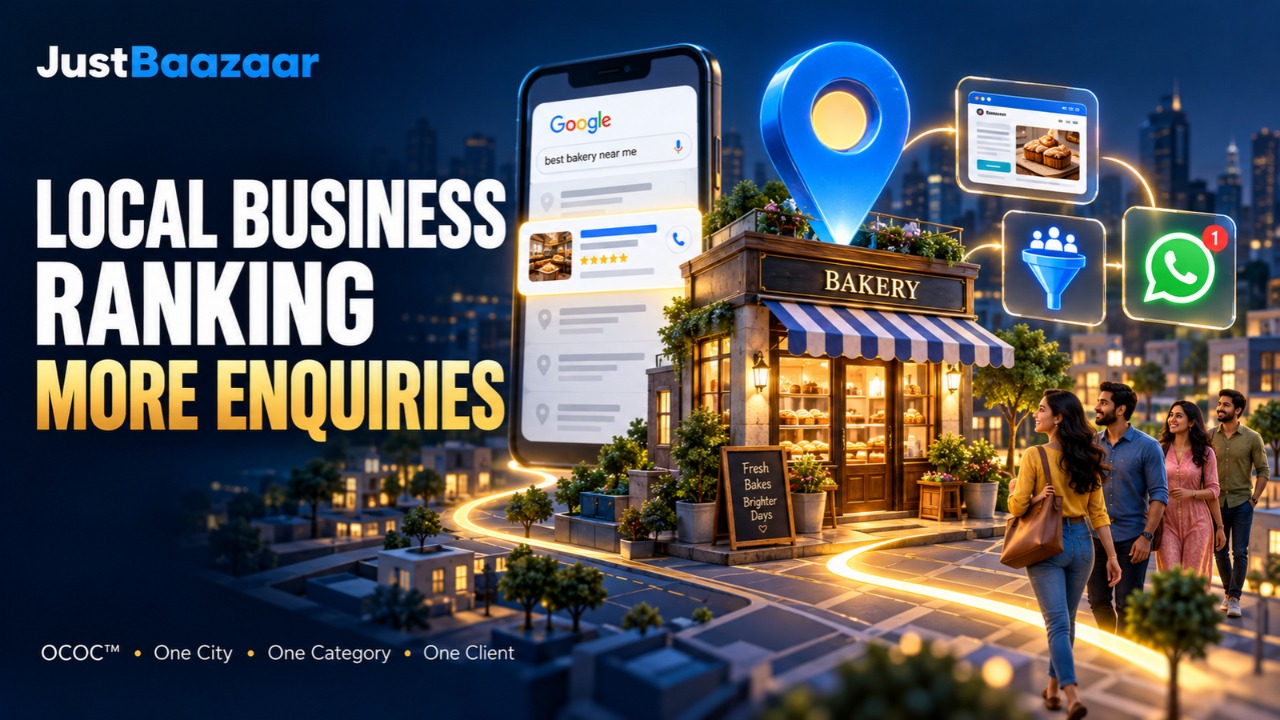
Local business ranking describes where a business appears for searches connected to a location. These searches may show map listings, business profiles, and ordinary website results. Someone might search for a coaching institute in Aligarh, a wedding photographer in Agra, or an interior designer near their home.
The important word is relevance. A thousand visitors from places you cannot serve may be less useful than a small group of nearby people who need your service. Your strategy should connect the right service, the right customer, and the right location.
Google explains that local results mainly depend on relevance, distance, and prominence. You can improve the accuracy and usefulness of your online presence, but you cannot control every searcher's location or promise the same position everywhere. See Google's local ranking guidance for the official explanation.
For a business owner, the practical goal is better visibility where suitable customers search, supported by a strong reason to choose you.
2. Think beyond ranking: build the complete customer journey
A customer rarely makes a decision because of one isolated marketing activity. They may discover your profile, read reviews, visit your website, check Instagram, and then send a WhatsApp message. Each step either increases confidence or leaves another question unanswered.
Picture a parent comparing coaching institutes. One institute has clear batch information, teacher introductions, directions, and an enquiry option. Another has attractive posters but no explanation of what happens after admission. The first business makes comparison easier. That clarity supports a more useful conversation.
I recommend designing five connected stages: discovery, understanding, trust, enquiry, and follow-up. Ask what the customer needs at each stage. Then give each stage a page, message, or team responsibility.
This approach also helps you diagnose weak results. If people visit but rarely enquire, examine the offer and page. If enquiries arrive but appointments remain low, examine response quality and scheduling. The solution becomes more specific when you understand where the journey slows down.
3. Make your Google Business Profile genuinely useful
Your Google Business Profile should help a customer answer basic questions immediately. What does this business do? Where is it? When is it open? How can I reach the team? Is the service relevant to my requirement?
Review your actual business name, appropriate categories, contact information, hours, website destination, and service details. Use current photographs that accurately show your business. An outdated entrance photograph or incorrect holiday schedule can create confusion before a conversation begins.
- Keep the phone number active and assign someone to answer enquiries.
- Describe actual services using language your customers understand.
- Check directions and location information against the real premises.
- Update hours when your operating schedule changes.
- Link to a useful page that matches the customer's likely need.
Ask genuine customers for honest feedback without coaching the answer. Respond professionally and use feedback to improve service. A review response is also a public example of how your business communicates.
Treat profile maintenance as a regular operational task. The aim is to keep the information dependable whenever a potential customer discovers you.
4. Build a website that helps people take the next step
A useful local business website explains your service quickly. The first screen should tell visitors what you offer, whom you serve, where you operate, and how to start a conversation. A customer using a phone should understand these points without searching through several menus.
Give important services their own pages when they require different explanations. A salon's bridal service deserves different information from its routine haircut service. A business consultant's ongoing advisory package needs a different explanation from a single workshop.
Each service page should include the problem addressed, the service process, relevant experience, practical expectations, and one obvious action. Where appropriate, explain how quotations work. Clear information can attract better matched enquiries and reduce repetitive questions for your team.
Keep pages light. Use readable text, appropriately sized images, simple navigation, and working contact links. Test your website on an ordinary mobile connection. A beautiful page becomes valuable when a real customer can read it comfortably and complete the intended action.
Your website should feel like a helpful first conversation with your business.
5. Publish service content that matches buying questions
Start your content plan with questions your team hears before a purchase. What does the service include? How long does it take? Who is it suitable for? What information is needed for a quote? What should customers compare before choosing a provider?
A photographer could explain how to compare wedding photography packages. An interior designer could explain the stages of a kitchen renovation. A coaching institute could explain how parents can assess a course before joining. Each article should help the reader make a practical decision.
Use genuine local details where they affect the service. These may include travel coverage, appointment availability, delivery boundaries, or the process for an on-site visit. Repeating a city name throughout a generic article adds little value.
Connect relevant articles to the service page that answers the next question. A reader learning about kitchen planning should easily find your kitchen design service. Someone comparing digital systems can explore the OCOC™ business growth framework . Helpful connections make your content easier to navigate and give interested readers a natural next step.
6. Create organic lead generation around real intent
Organic lead generation means attracting enquiries through unpaid discovery channels such as search results, helpful content, referrals, and social media activity. It still requires investment in expertise, implementation, and maintenance. Its value comes from building useful assets people can continue discovering.
Different searches reveal different levels of readiness. Someone asking what local SEO means is learning. Someone comparing local SEO services in their city may be choosing a provider. Both visitors deserve useful answers, but their next steps may differ.
Build content for three stages. Educational articles explain the problem. Comparison pages help people evaluate options. Service pages explain your solution and invite a suitable enquiry. This creates a connected route from curiosity to a business conversation.
Give every article a purpose before writing it. Define the reader, the question, the useful answer, and the next action. A focused article can strengthen your sales process because your team can also share it when similar questions arrive on WhatsApp or email.
7. Understand SEO, AEO and GEO without the confusion
SEO means Search Engine Optimisation. AEO is commonly used for Answer Engine Optimisation. GEO usually means Generative Engine Optimisation in this context. These terms describe overlapping efforts to make useful information discoverable and understandable across search and answer experiences.
| Approach | Main focus | Practical content choice |
|---|---|---|
| SEO | Relevant search discovery | Clear service pages and useful internal links |
| AEO | Direct answers to questions | Question headings with concise explanations |
| GEO | Understandable information for generative answers | Specific facts, clear attribution and supporting sources |
Google says its existing SEO practices remain relevant to AI features and that special AI markup is unnecessary. Its guidance on AI features and websites is a useful starting point. Eligibility does not guarantee inclusion.
My practical recommendation is to answer questions clearly, explain your services consistently, identify the author, and support factual claims. These choices help readers assess your expertise. They also give discovery systems clearer information to work with, without pretending that any content format guarantees an AI recommendation.
8. Make your expertise easy to understand and verify
Customers should be able to understand who runs the business and why that person or team is qualified to help. Introduce relevant experience, describe your working process, and explain the scope of your service in ordinary language.
Specific information is more convincing than broad praise. Instead of saying that your service is exceptional, explain how an enquiry is assessed, how work is approved, how progress is communicated, and who handles questions. These details allow a potential customer to imagine working with you.
Use examples responsibly. If you publish a customer story, obtain permission where necessary and describe the actual work and results accurately. If an example is hypothetical, label it clearly. Readers should be able to distinguish an illustration from a documented outcome.
Keep your name, service descriptions, and contact details consistent across your main online properties. When customers move between your profile, website, and social channels, the business should feel familiar and coherent. Trust grows when the information supports itself across the whole journey.
9. Use a funnel to make the next step obvious
A funnel is a planned sequence that helps a person move from initial interest to a suitable action. For a local business, it can be very simple: a service page, an enquiry, a confirmation, and a conversation with the team.
Suppose an interior designer offers a project discussion. The page explains who the discussion is for, what information to prepare, and what happens afterwards. The enquiry captures the location and project type. The confirmation explains when the team will respond. Every step reduces uncertainty.
A good funnel asks only for information needed at that stage. A long form can feel demanding when the visitor is still exploring. Begin with essential details and collect additional information during the conversation.
Your offer should also match your capacity. Invite consultations only when someone can handle them properly. A funnel supports growth when the promise on the page matches the experience after the click. For a broader introduction to funnel tools, read our Systeme.io review and assess features against your actual workflow.
10. Make WhatsApp follow-up organised and personal
WhatsApp can be a convenient starting point for business conversations. The important question is what happens after the message arrives. Who reads it? Who replies? What information is needed? How does the team remember the next action?
Create a simple process for new enquiries, active discussions, scheduled appointments, and completed requests. A shared lead tracker can help even before you invest in advanced systems. Every enquiry should have an owner and a clear next step.
Use automation for predictable tasks such as acknowledgements, routing, and agreed reminders, with appropriate permissions and platform requirements. Make human help accessible for questions that require judgement. The purpose is to support a useful conversation.
A helpful opening might say: “Thank you for contacting us. Please share your city and the service you need. Our team will guide you on the next step.” Keep any response-time promise realistic.
Follow-up messages should contain useful information and respect the person's communication preferences. Relevance builds a stronger relationship than repeated messages asking whether they have decided yet.
11. Use email to answer questions over time
Some buying decisions need more than one conversation. A family planning a renovation or a business evaluating a marketing partner may take time to compare options. A thoughtful email sequence can support that process when the person has agreed to receive it.
Begin with a clear welcome message that delivers whatever was requested. Follow with useful explanations: how the service works, what information helps with planning, and which questions to ask before making a decision. Each message should have one purpose.
For example, a business growth sequence could explain local visibility first, website conversion second, and follow-up organisation third. The final invitation can offer a discussion about the reader's specific situation.
Write emails as you would speak to a respected customer. Use clear subject lines, short paragraphs, and a practical next step. Include an easy way to stop receiving marketing messages. A smaller audience that welcomes your communication can be more valuable than a large list with little interest in your service.
13. Connect your channels with one shared message
Integration begins with a clear promise. Decide which customer you serve, which problem you solve, and what makes your process useful. Then express that promise consistently across search listings, service pages, social profiles, and follow-up messages.
Consider a coaching institute promoting a course for working professionals. Its website explains the schedule. Its social posts show the learning approach. Its enquiry form asks about availability. Its follow-up confirms the next suitable batch. The channels reinforce the same decision.
Document the journey in a short internal note. Include the enquiry sources, the main offers, the person responsible for replies, and the information needed for a qualified conversation. Your team should know where each lead goes.
Review the journey whenever you change an offer. Update the relevant page, profile links, messages, and team instructions together. A connected system becomes dependable through regular maintenance. Even a simple setup can work well when the customer receives clear and consistent information throughout the process.
14. Measure what happens after the click
Search visibility helps you understand discovery. Business outcomes help you understand whether the customer journey works. Track both, and keep the report simple enough to use during an ordinary review meeting.
- Discovery: relevant search impressions, website visits, and profile interactions.
- Enquiries: completed forms, connected calls, and actual WhatsApp conversations.
- Quality: enquiries that match your service area and customer requirements.
- Progress: appointments, quotations, and completed follow-up actions.
- Outcomes: customers acquired and the revenue connected to them where reliably recorded.
A contact-button click is an indication of interest, not proof of a completed enquiry. Record actual conversations separately so the report reflects what your team experienced.
Here is a hypothetical illustration: 100 relevant visits generate eight enquiries and two customers. The next improvement might involve increasing relevant visits, strengthening the page, or improving enquiry handling. These are example numbers, not a JustBaazaar case study or promised result.
Use the data to choose the next action. A report becomes valuable when it helps the business make a better decision.
15. What is OCOC™ by JustBaazaar?
OCOC™ means One City • One Category • One Client. It is JustBaazaar's framework for building a connected digital growth and customer acquisition system for local businesses. Its positioning combines strategic focus with category and city exclusivity, subject to an agreed scope.
The framework brings together local SEO, website improvements, funnels, WhatsApp processes, email nurturing, content, and brand communication. The combination should reflect the business's current needs. A company with good enquiry volume may need better conversion before it needs more traffic.
The exclusivity principle deserves a proper discussion. Confirm how your city, category, service coverage, and engagement are defined. Availability should be checked directly; this article does not claim that a particular category is open or reserved.
Explore OCOC™ by JustBaazaar to understand the approach. Then bring your business details into the conversation. The objective is a practical growth system with clear responsibilities and measurable progress.
16. Which businesses are ready for this approach?
This approach suits businesses that offer a real service, can handle customer enquiries, and want to build a stronger digital foundation. Examples include coaching institutes, professional firms, salons, gyms, retailers, restaurants, consultants, and local service providers.
Readiness matters more than the size of the office. Are your services clearly defined? Can you share accurate information? Will someone respond to enquiries? Can your team deliver the experience described online? These questions reveal whether increased visibility can translate into useful growth.
Be honest about capacity. A small team may need one priority service and one clear enquiry route first. A larger business may need separate journeys for different branches or customer groups.
I encourage owners to treat digital growth as a shared implementation effort. Your knowledge of customers, pricing, operations, and service quality is essential. A digital partner can organise and improve the system, while your business supplies the expertise and delivery that make the promise meaningful.
17. A practical first 90 days of implementation
Use the following roadmap as a planning example. The order and pace should change according to your existing assets, access, team capacity, and priorities. Ninety days is an implementation window, not a ranking deadline.
Days 1–30: establish a clear foundation
Review the business profile, website, service information, and enquiry handling. Choose one priority customer group and service. Correct important information, clarify the offer, repair broken contact routes, and record a starting performance baseline.
Days 31–60: connect discovery and enquiries
Improve the priority service page, publish useful supporting content, and connect relevant social profiles. Set up an enquiry tracker and an agreed response process. Test the journey from a customer's phone, including confirmations and team handovers.
Days 61–90: improve using actual conversations
Review which questions customers asked and where enquiries slowed down. Update pages and messages accordingly. Strengthen the best-performing content and identify the next service worth developing. Agree on the following implementation cycle using evidence from the business.
18. Choose a digital growth partner with clear questions
Before choosing a provider, ask how the work connects to your business objectives. Request a clear scope, named responsibilities, an implementation sequence, and an explanation of how progress will be reviewed.
Ask who controls the domain, website, business profile, advertising accounts, and customer information. Your business should understand its access and ownership arrangements. Also clarify ongoing software costs, content responsibilities, and what happens if the engagement ends.
Discuss the practical details of reporting. Will the report show activity only, or will it connect activity with relevant enquiries and outcomes? Who helps interpret the findings? How will priorities change when the evidence suggests a different problem?
A useful proposal should explain the first priority and why it matters. When you speak with JustBaazaar, bring your current website, main service, city, and growth challenge. That gives the discussion a concrete starting point and helps both sides judge whether the proposed work fits your business.
A five-minute check you can do today
Open your business website on your phone and pretend you are visiting for the first time. Can you identify the main service immediately? Can you find the location and contact option? Does the contact link open correctly? Then ask a team member to explain how a new enquiry is recorded and followed up. Write down the first three improvements you notice. Choose one owner for each task and a realistic completion date. Small, completed improvements give your business a stronger foundation for the next stage of growth.
Frequently asked questions
What is the difference between local SEO and website SEO?
Local SEO focuses on discovery connected to a place or service area, including business profiles and local pages. Website SEO covers the broader discoverability and usefulness of website content. For many local businesses, both support the same customer journey.
Can I generate leads without paid advertising?
Yes, enquiries can come from organic search, referrals, useful content, and social activity. Volume depends on demand, competition, your offer, visibility, and conversion. Organic growth still requires consistent work and does not guarantee a fixed number of leads.
How long does local business ranking take to improve?
There is no universal deadline. Your starting position, competition, website quality, profile accuracy, and implementation pace all matter. Agree on a baseline and review progress regularly. Useful operational improvements can happen before major ranking changes become visible.
Do I need a large website to begin?
No. Start with the pages customers need to understand your main services, assess your business, and contact you. Expand when additional services or questions justify useful new pages. Clarity and maintenance matter more than publishing a large number of thin pages.
Does AEO or GEO guarantee that AI tools recommend my business?
No. Clear answers, reliable information, and accessible pages support discoverability, but platforms decide what to display. Treat AEO and GEO as content and visibility disciplines. Measure relevant referrals and enquiries instead of relying on promises of guaranteed mentions.
How much does an integrated growth system cost?
Pricing depends on the work required, the number of services or locations, existing assets, integrations, and ongoing support. Ask for a scoped proposal that separates implementation, recurring services, and third-party costs. Share your business details for a relevant discussion.
Can JustBaazaar support an existing website?
Share the website and your objectives so the team can assess the current setup. The appropriate scope may involve improving existing pages, connecting enquiries, strengthening content, or recommending technical changes. The starting point should follow the assessment.
How do I check OCOC™ availability?
Send your business name, city, category, and main service to JustBaazaar. Ask the team to confirm availability and explain the proposed exclusivity boundaries. Category availability and commercial terms need direct confirmation before any engagement begins.
Let your next customer find a clear path to you
You already invest energy in running your business. Give that effort a digital system that helps suitable customers discover your service, understand your value, and start a useful conversation.
At JustBaazaar, we begin with your business situation: what you sell, whom you serve, where you operate, and which part of the journey needs attention. From there, we can discuss local visibility, website improvements, funnels, and follow-up in a connected way.
Send your business name, city, category, website link, and biggest growth priority. Ask us about OCOC™ availability and the scope that could fit your business.
Check OCOC™ Availability on WhatsAppWhatsApp: +91 97599 99231 · You initiate the conversation by sending your message.
 Launch your Graphy
12. Make social media support business trust
Social Media Optimisation starts with a profile that explains your business. Your name, description, location, contact route, and linked page should make sense together. Someone discovering a single post should be able to understand what you offer within a few moments.
Build content around customer questions, your working process, useful demonstrations, and genuine business updates. A furniture business can explain materials and measurements. A salon can explain preparation for an appointment. A consultant can explain how a first discussion is structured.
Assign a purpose to each post. Some posts introduce the business. Others answer objections or invite enquiries. This helps you evaluate content beyond likes and views.
Link interested visitors to the most relevant destination. A post about one service should lead to details about that service, rather than forcing people to search a general homepage. Keep the language and offer consistent between the post and the destination. That continuity helps visitors understand they have arrived in the right place.